


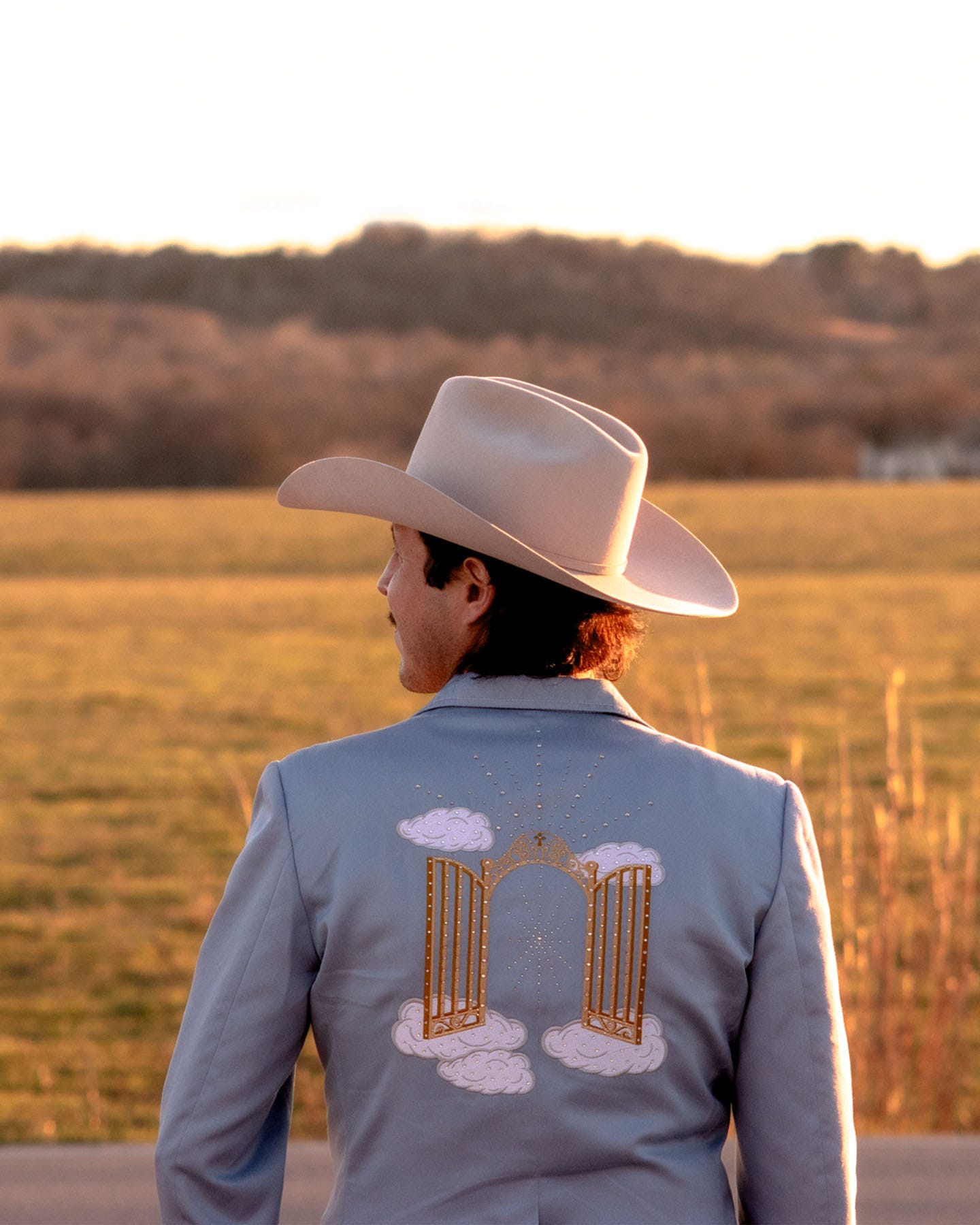
This interview has been edited for clarity.
DD: Cory Cross! Welcome to the Texas Tailgate Podcast. How are you doing, bud?
CC: Doing well.
DD: You had to rush down here through traffic to get here. I do like your painter whites. You look like you’re about ready to go paint a house.
CC: Yeah, it looks that way. I’m not actually but it looks that way.
DD: Thank you for coming. I’ve been wanting to get you on to talk about your new album “There’s More”, which is a very interesting title. Where’d that come from? Why is it “There’s More”?
CC: I feel it’s got some, I don’t know, it’s got a little spice to it. I felt like for the title of an album, especially our debut full length album, - you know there’s definitely going to be more albums to come so there’s that - it’s a little intriguing. Honestly, I wrote the song “There’s More”, the title track off the album, specifically for this project. I knew I wanted it because we do tongue and cheek honky-tonk music. A lot of our more popular songs are fun, silly two-stepping songs, but for the title track I wanted something a little bit more serious and personal. “There’s More” just felt like it had some hope to it.
DD: Tell me where did you record this thing and where did this develop?
CC: We recorded and tracked everything Austin Choate, the drummer. He produced and engineered all of it. Mix and master. He did all at Weatherford College. He works there as well.
DD: That’s cool. I didn’t know they had a studio. Is that where you recorded it too?
CC: Yes, they have a really nice studio.
DD: Weatherford College in Weatherford, Texas?
CC: Yeah and there’s a man that works there, his name is Tim Kimsey. He’s worked with Vanilla Ice. He’s worked with Pantera. He heads up the Weatherford College recording program. You can go as a student and learn how to do all that stuff. They hooked it up for us. It was great.
DD: Is Austin still a student?
CC: He’s not a student anymore. He actually works for the program.
DD: Excellent. That’s very fortunate for you.
CC: For sure, because that can get expensive real quick. A whole album is very expensive.
DD: The whole album is a honky tonk album but it’s got an indie rock feel to it. I was listening to “Crying In A Honky Tonk” and there’s something about twin vocals on there that has a Waylon sound but through an indie rock feel.
CC: That was on purpose. A lot of the references that I gave Austin - bless his heart man because I’m not I’m Tech like savvy when it comes to the recording and engineering process - I was just sending him a million songs and just random references like Blink 182. They sort of have those on a lot of their earlier stuff and the Beach Boys that have layers and layers of vocals. It was on purpose that a lot of the references I gave him were rock and roll references. Waylon has some of that like heavy reverb type stuff on some of his earlier recordings. All the guys in The Burden, Kyle Farley on Bass, Matthew Walton on steel, Austin Choate, we all played in rock and roll bands in our early 20s and that’s the stuff that we first started listening to on our own when we were deciding what music we wanted to listen to as 15 and 16 year olds. It was all garage rock, punk rock, indie rock. That type stuff. Now that we’ve come back to country music - the stuff that we were fed when we were kids by our uncles and dads and grandpas - that Indie garage Rock just trickles in. Especially when we play live.
DD: Tell me tell me a little bit about the first track that we recently released, the single “100 Miles”. It starts off the album. Who is that at the beginning telling you they got you a gig?
CC: We met that woman on our first tour when we went out west to California while we were in Phoenix. She was there with some of her nieces. I don’t really know the specifics of the story because Kyle and Austin met her. She loved our music. There was beer flowing and there were shots taken. I guess she had a friend who knew a friend who had a friend who was booking for some festival that didn’t pan out but we got a good voicemail out of it. That voicemail was left on Kyle’s phone and they thought it would be funny to add that to the track. It’s random.
DD: The track is about being on the road. Where did that song come from? You’re counting down the miles getting home. It’s a trope within country music, being on the road and getting home. You put a very interesting spin on it. Tell me where did that come from? All of these songs you wrote them all? Right?
CC: Correct. That is true. I was in a hotel room in Austin, TX, and I’m pretty sure that it was a 5-day run. I know I wrote it in Austin and I know that at the time I was ready to get home. I’m pretty sure that I was actually counting down the days because my fiancé and I were going on vacation and I was getting ready to propose. I was especially anxious to get this run over with so that I could propose to my girlfriend and hopefully she’d say yes. She did say yes. We love what we do. I love what I do, but when you spend five nights in a row - sharing a bed sometimes - you know these Hotel breakfasts. It can get to you. I started to miss my fiance. Austin Choate, again, it was his idea to have each chorus count down so it starts with 300. When I first wrote it, it was just 300 miles and that was going to be what it was for each chorus. He was the one who decided to count it down. That’s a pretty good addition.
DD: There’s so many good songs like “Six Days on the Road” and “Houston” by the Gatlin Brothers where we’re trying to get home.
CC: Cory Morrow, “21 Days”. That’s what the first line - “I’ve been 21 days on this highway” - that 21 days is a nod to that Cory Morrow song. We got to open for him in Denton. I’ve been listening to Cory Morrow since I was 15. That’s a nod to one of my favorite counting down the days, being on the road: Cory Morrow’s “21 Days”.
DD: The next song that we put out was “Crying in The Honky Tonk”. We talked about it a little bit. You went out to California on a run and made a really cool music video. Tell me how that came about.
CC: We have a buddy, Chase Manhattan, that we met the first time we went out to California. He was booking the Desert 5 Spot in Hollywood and he’s a great guy. We kept in touch after the run. He was moving more towards filmmaking and I just reached out to let him know we were going to be in California. We filmed it at Maui Sugar Mill during one of our shows. He brought in a full crew. He brought in some actors and stuff. We had a bunch of our friends we made in Los Angeles just come out and drink and “act”. It was a blast man. A little awkward for me and the guys. None of us have ever done anything like that.
DD: Most of your videos have been live videos.
CC: Exactly. We did our set and then afterwards Chase had us do different stuff with our faces. It was a little awkward but it was fun.
DD: There’s always been a Texas/ California rivalry. A pleasant rivalry. There’s a label that Smith Music Group distributes out of L.A. called Blackbird record label. Really cool cats out of there. What’s your opinion on the differences between the Texas Country scene and the California country scene? Do you get into that?
CC: I know it’s blasphemous to say but there’s some good stuff. I love Los Angeles and I love the people that we’ve met there. They are so welcoming. We booked that tour a year ago not really knowing what that scene was like. We obviously know the sort of musical history when it comes to country music. We know about the Bakersfield stuff and Merle and you know but a lot of guys went out there. They made sure that they toured around California. Kris Kristopherson and moving to Hollywood. We knew all that but we didn’t know what it was going to be like when we went out there. All we knew is that we had listeners out there, so that was really why we decided to go. We knew that some guys that we listen to like you know like Jesse Daniel were doing stuff out there. We went out not knowing what to expect. The people that we met - the crowds - were just so welcoming. Very fun. The musicians were good. We really enjoy it. It’s different. It’s more tongue-in-cheek. You go out and everybody’s got their rhinestone suits on. It feels a little like dressing up, which is fine. I’m from the suburbs. I live in an apartment complex. We do our little runs around Texas, small towns. A lot of times we’re playing to actual good old boys
DD: You got blown up on social media for wearing tennis shoes somewhere recently.
CC: Right. We get that. We get “you got soft hands” or whatever. We get those comments online but obviously Texas is our home and where I grew up. The reason that I started writing country music was because of Texas Red Dirt country. You know that is where my creativity - when it comes to writing country music - sprang out. But we love going out to Los Angeles
DD: What most artists I’ve dealt with forget that there are scenes everywhere; scenes all over the place. There are people who make a killing because they understand that that is how they can really survive by getting connected with those scenes. There’s people like BJ Barham. He is a good example. He’s from North Carolina but he goes out to the West Coast. He comes to Texas. He tours and gets embedded with those local scenes. Now he’s a local without being a local. California’s got some good stuff. I’m a real big fan of Ted Russell Kamp’s stuff.
CC: When we played the first time at Desert 5 Spot, we did our set but then there was a house band. The way it worked there was a house band that had solo artists come up and do their songs. The house band learned their songs beforehand and played with them so it was kind of like a very structured open mic. We did our set and Chase said “Hey, do you want to do one song with the house band”? Ted Russell was on bass.
DD: He’s Shooter Jennings bassist for a lot of stuff and we distribute a couple of his albums.
CC: Vincent Neil Emerson is working with Shooter. There’s quite a bit of a crossover and so many people just went into the studio with him. Austin to L.A. I lived in Austin and we go down there a lot. Just I10, straight there. The thing that we enjoy the most about our time when we go to California or when we go to New York City - we did New York City last December. We’re doing that again coming up with Aaron McDonald. We love the people that we play to in Texas, but if you go to any barbecue joint in DFW, there is a good chance you’re going to get a pretty good, talented country singer-songwriter on a stage somewhere or in a corner. I feel like around here we’re a little spoiled. You know it’s just there’s many really great singer songwriters in country music, Americana. When we go out to California maybe there’s not as much. It’s just a different genre out there. It’s a big, big deal. It feels more like a special thing.
DD: Tell me about your experience with country music lovers in New York. What was the experience there? I’ve noticed you posting about it. There’s a promoter that you’re working with out there?
CC: Two of them. They’re DJs, actually. It’s DJ Prison Rodeo and DJ Moonshine.
DD: What kind of crowd is that? What are they looking for in a in a country artist out there?
CC: Those guys, DJ Prison Rodeo and DJ Moonshine, just got Charlie Crockett in there to do his album release. They are true fans and they know country music. The crowd, I don’t really know whether they know country music or not, but I do know that they loved what we were doing. They had the cowboy hats on. There were chaps out there. People with actual Spurs on, like they were just ready to party and dance. They knew how to two-step. Again, it was just a big, special thing and a band from Texas felt like maybe a little bit of a novelty. We got a Real Deal Texas country band coming to New York City. Everybody was so sweet and so enthusiastic. We had a blast.
DD: How I dig that you’re exporting the content - the lifestyle - outside the state. You’re an ambassador. You’re definitely bringing good music to the masses up there. We need to talk about that album. I’ve got notes. “Good Enough Today”. A honky-tonkin’ sad song. Where’d that song come from?
CC: I wrote that so long ago. I’m 36 now. I think I wrote it when I was 22 or 23. Back when I was living in Austin playing coffee shops and hookah bars, wearing suspenders and a fedora, or skinny jeans. You know, just Austin in 2008. It just stood the test of time. I don’t know. I just wanted to write something like a waltz-type song. When I used to do it, it didn’t sound anything like what the track sounds like on the album. The guys - Matt on steel and my buddy Joseph Fields who plays piano on it, he actually plays at my parents church and he does that piano part which is just so beautiful. Brandon Arthur who’s in Denton did the fiddle. It just stood the test of time somehow because most of the songs I wrote back then I retired a long time ago. It’s just one just stuck around. My fiance actually sang Harmony on it.
DD: She’s accompanied you on a few things that I’ve been a part of. The One Mic Session we did over at Cloudland. Y’all have a killer rapport, just y’all two by yourselves. Makes for a very entertaining time. Then you add on all the layers, it sounds fantastic. What made you decide to make it one of your singles for the upcoming album?
CC: I think because the songs that have taken off more or less have been our more Outlaw type stuff- as far as instrumentation, rhythm, tempo. “Done Being Good for Good” and the Honky Tonk, swinging type like “Too Drunk to Swim”. I wanted to feature a more melancholic, more serious type of song.
DD: Let’s talk about “Done Being Good for Good”. Very similar but goes in a different direction. Where did that one come from because that one’s very much a Waylon feel.
CC: I wrote specifically for our live set. Once I got Kyle Farley and Austin Choate, we started playing regularly. We were pretty much doing half and half covers and Originals. When you have a rotating door of musicians, you know you can just say “we’re going to play Lonesome On’ry and Mean in D” and they’re like “okay, yeah.” No need to rehearse. We got it. But then when you get guys that are willing to play regularly and rehearse, I can start writing some songs now and I wrote that specifically because at our live shows those types of songs - Lonesome On’ry and Mean, Only Daddy That’ll Walk the Line, White House Road - the more Outlaw type songs are always a hit. Let me write one. Really, that’s what it was. I just wanted to fill that space in our live set so that we could start moving towards mostly original music.
DD: That’s one of the frustrating parts about being a musician in Texas. You got to play covers just to grab people’s attention so they’re there long enough. I’m guessing you are you moving away from that. Are you getting there were some of your shows now can be mostly originals? You’re getting the fans out there finally.
CC: We’re at that place now. We did those three hour, 70% cover gigs for about two years. Now we’re doing mostly 90 minutes, all originals except for like one cover. That’s where we’re at right now. I still do a lot of the three-hour solo stuff. I gotta pay the bills, but as far as the band goes most of our shows now are 90 minutes. We have about three hours of original material now.
DD: I have been enjoying watching your career move and it’s going to keep moving up. It’s going to keep growing. I dig you because you’re not a cookie cutter on the Texas front. You’re not a Randy Rogers ripoff band. There’s a lot of Koe Wetzel clones out in the world at the moment. To see somebody taking a nice melting pot of Texas, that honky mix of honky tonk and indie rock, that I’m really digging. I love that you’re exporting it out in the world. The album drops on June 21st. What’s the plan? You’ve got some upcoming shows to promote it?
CC: We’re actually doing June 22nd at The Kessler with Matt Hillyer. Doing a double album release show. The Kessler’s a great room. That’s been a bucket list venue for all of us for so long. The first show I saw there was Joshua Ray Walker three years ago. Beautiful room. And then Matt, I’ve been listening to him, 1100 Springs, for forever. I remember riding around listening to 1100 Springs in the first truck I ever got at 16 or 17. It’s a really cool thing and we’re very grateful.
DD: Is that the only release show you’re doing?
CC: We are playing the 21st also. We’re doing the Magnolia Motor Lounge. We’ll do Fort Worth and then Dallas. I wanted to make sure I mentioned Tim Kimsey. He kind of oversaw the album. He was nominated for a Grammy for his engineering work. Tim Kimsey at Weatherford College. He really helped us out there. // TT